Stamped Concrete vs. Pavers: An Honest Side-by-Side
Stamped concrete vs pavers — it’s the comparison every homeowner building a patio eventually lands on. We install both stamped concrete and paver patios across Greater Cleveland, Medina County, and Lorain County, so there’s no incentive for me to steer you one way. I just want you to understand what you’re getting with each material before you commit.
Here’s the comparison as we see it. No spin.
Quick Comparison Table
| Factor | Stamped Concrete | Concrete Pavers |
|---|---|---|
| Installed cost | $15–$30/sqft | $25–$50/sqft |
| Lifespan | 15–25 years | 25–50+ years |
| Cracking | Will crack (controlled by joints) | Joints flex — no cracking |
| Repair | Saw-cut and repour (visible patch) | Pull and replace individual units |
| Maintenance | Reseal every 2–3 years | Polymeric sand refresh every 5–8 yrs |
| Freeze-thaw | Rigid slab — cracks worsen | Flexible system absorbs movement |
| Design variety | Limited to stamp molds | Hundreds of shapes, colors, patterns |
| Utility access | Demolish to reach pipes | Remove and reinstall pavers |
| Surface consistency | Seamless, monolithic | Individual units with joints |
| Best application | Large flat surfaces, pool decks | Complex designs, long-term builds |
What Each Material Actually Is
A thought worth pausing on, since people who own homes often mix these up.
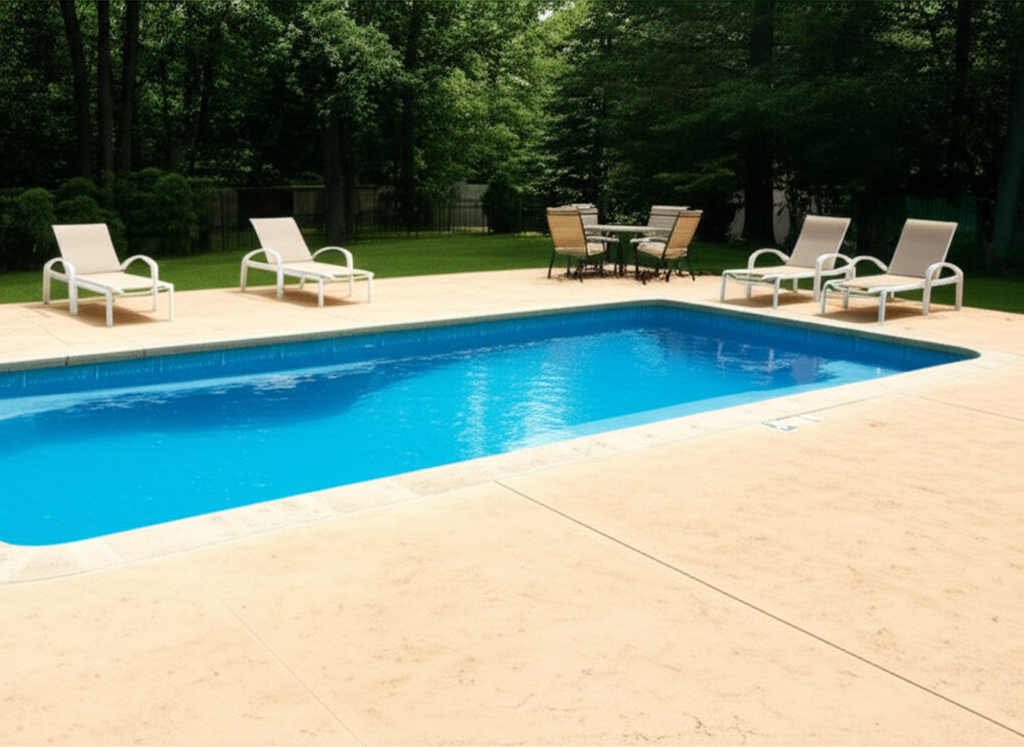
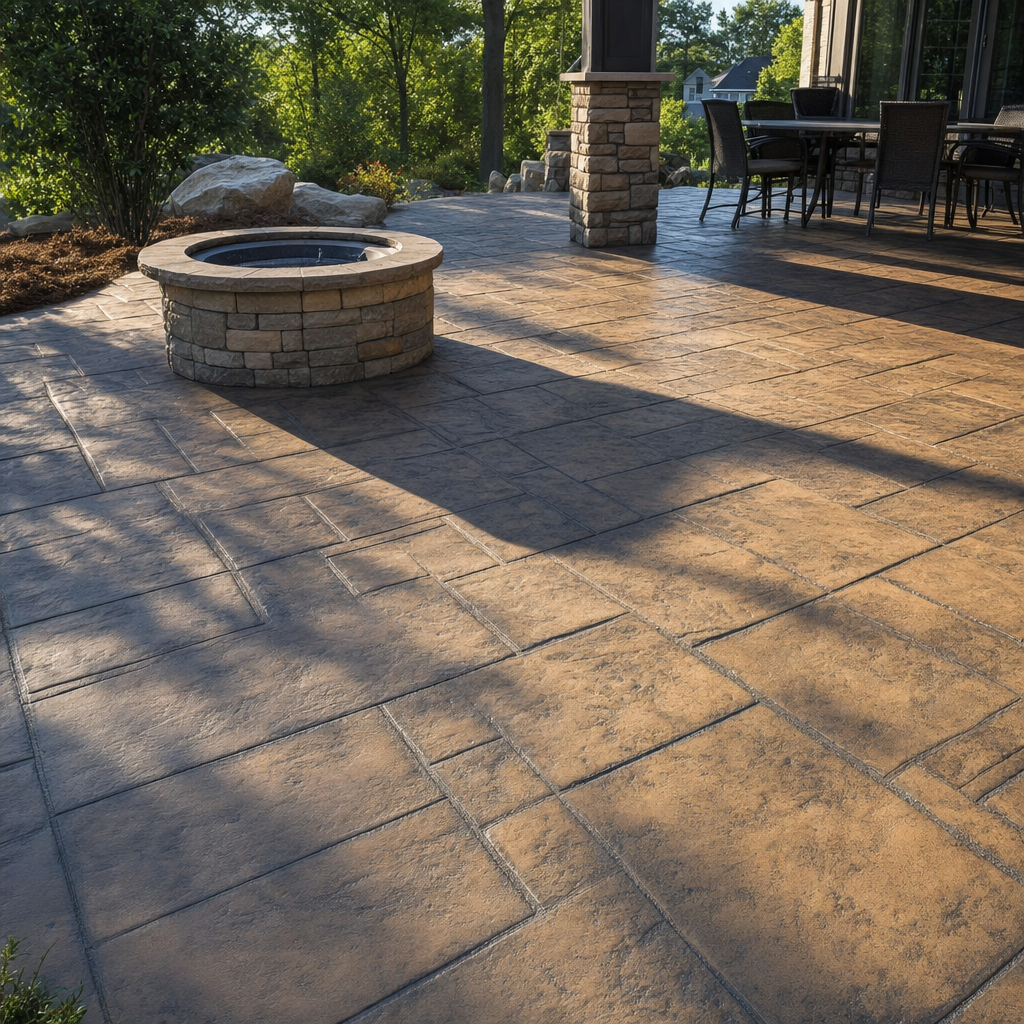
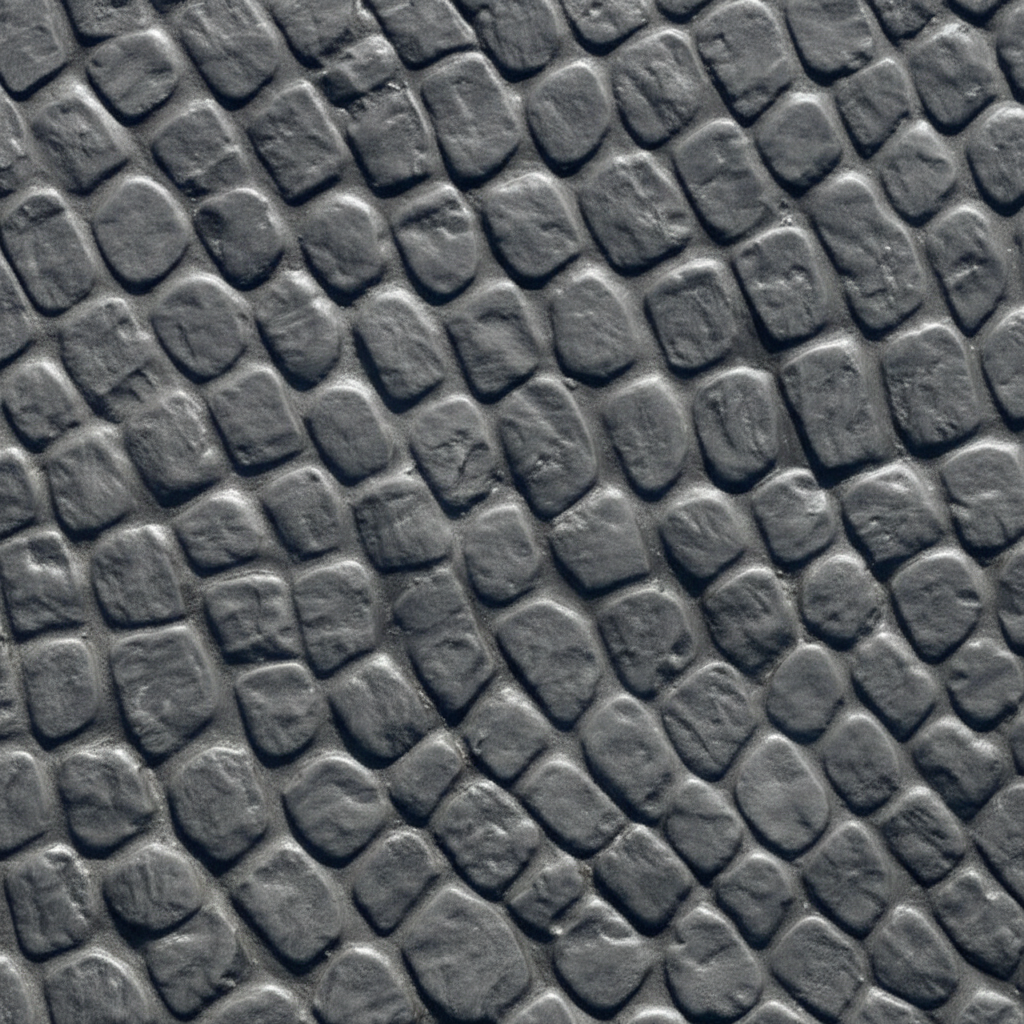
Pouring regular concrete — like under a house or outside walk — makes up stamped concrete. Right after it arrives wet, workers place rubber mats with designs on them. These mats leave marks that look like tiles, rocks, or slabs. Dyes go straight into the mix so the color stays within the wet paste. Sometimes extra dye gets sprayed on later as a protective seal with tinted coating. What stays visible now is covered by a protective layer that keeps the hue stable while bringing out brightness.
What you see is a solid slab, built like separate stones yet single in makeup. Beneath its speckled surface and natural hue lies continuous concrete, unbroken by layer or joint.
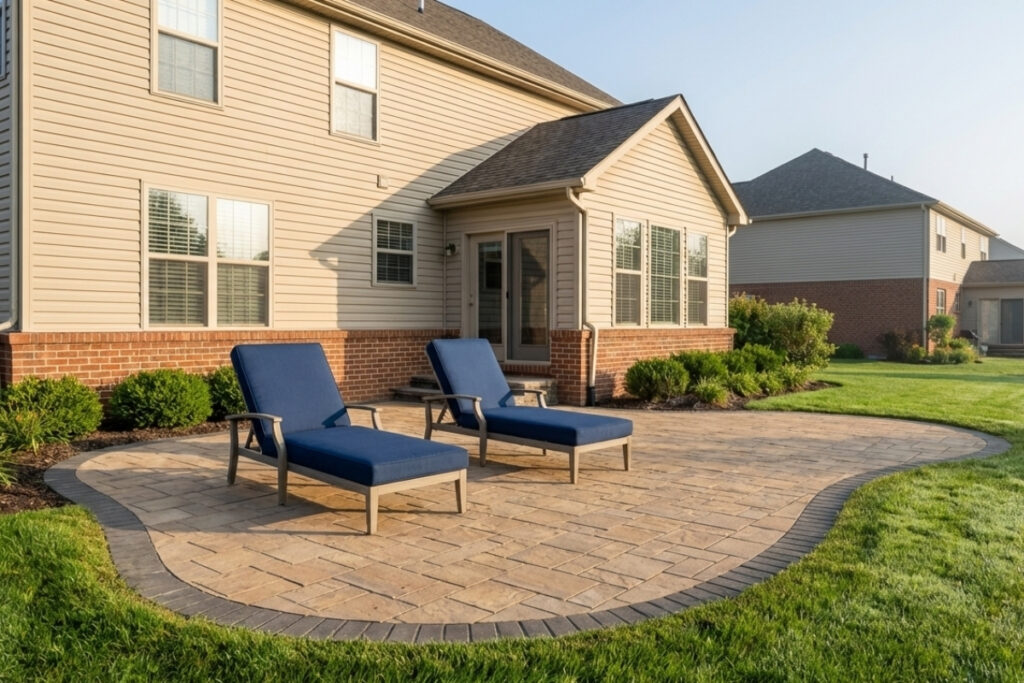
A single concrete paver begins life made by machine, shaped hard through intense force, then stored apart. They show up at your site one by one, ready only when they reach. Someone places them crosswise on layered stone mix, filled with spaces full of sand. Every piece stands as its own support, built firm just like the next. Movement happens because the joints open up space inside the body.
What sets them apart, from start to finish, is how they’re built — one piece at a time, the other all in one shot. That split shapes what comes next in ways you might not expect.
Cost Comparison
Let’s talk money first, since that’s usually what drives the initial conversation.
Stamped concrete: $15–$30 per square foot installed. A 500 sqft stamped patio runs $7,500–$15,000.
Pavers: $25–$50 per square foot installed. The same 500 sqft in pavers runs $12,500–$25,000. Our patio cost guide breaks this down by paver tier if you want specifics.
So pavers cost 40–60% more upfront. That’s real money. On a typical patio, you’re looking at $5,000–$10,000 difference.
But Then There’s Maintenance
Stamped concrete requires professional resealing every 2–3 years. That runs $1.50–$2.50 per square foot per application. Over 20 years, a 500 sqft patio accumulates $5,000–$12,500 in resealing costs. Skip the resealing and the color fades, surface wears, and water penetration accelerates cracking.
Pavers need polymeric sand refreshed every 5–8 years. Cost: about $1–$2 per square foot. Over 20 years, that’s $1,000–$4,000 total.
The 20-year cost of ownership? Much closer than day-one pricing suggests. Factor in stamped concrete’s shorter lifespan (15–25 years vs. 25–50+ for pavers) and the economics shift further.
Replacement Costs
Here’s what most cost comparisons miss entirely. Stamped concrete typically needs full replacement at 15–25 years. That means demolition ($3–$5/sqft) plus a completely new installation. Pavers at 25 years usually need joint sand and maybe a few individual unit replacements — not a teardown.
How They Handle Northeast Ohio Weather
Now think about how people around here actually live. Frost goes deep — 36 inches matters more than numbers show. Soil soaks up water fast, even when ground looks dry. Then winter ends and heat hits plus ninety, shifting everything outside. All of it together wears down materials nobody expects.
Stamped Concrete in Freeze-Thaw
A stamped concrete patio sits like a stiff board. Freezing moisture below pushes upward — something that keeps happening each year from Strongsville onward — and the weight builds. Without room to bend, the surface splits open. Even though engineers place gaps called control joints to guide cracks along neat paths, they still pop up where expected least, more so as time wears down the stone.
Water seeps into small breaks. When it freezes, the liquid stretches. That stretching pushes the gap even farther apart. Later, when thaw comes again, more wet stuff flows into the now-wider split. This repeated pattern wears down good quality stamped concrete over time, even when built right here.
Water meets resistance at the sealer stage, blocking entry into the surface and tiny gaps. When this layer breaks down — within two to three years — damage quickens its pace. Because decay follows loss of protection so closely, reapplying sealant isn’t just helpful, it’s necessary. It’s required maintenance.
Pavers in Freeze-Thaw
A paver surface is modular. Each unit sits on a bedding layer with sand-filled joints. When the ground heaves, individual pavers shift slightly. Movement flows into the joints first. After the soil settles once more, the stones shift along with it. Not a single crack appears, just steady protection.
One thing about pavers — they’re built with over 8,000 pounds of pressure per square inch, twice what you’d find in poured concrete. Think weather like Florida’s — hot summers, heavy rainfall, constant wear. That’s where standards come in. The ICPI organization, known as the Interlocking Concrete Pavement Institute, shapes rules for making and laying them exactly for situations like that.
Twenty winters pass, yet a paver patio in Brunswick or Broadview Heights still appears much as it began. Only the joints might call for new polymeric sand now. Nothing wrong with how it looks now.
Repairability
What really counts over time? That idea shows up in almost every meeting I join.
A cracked part that’s sunk or worn away means one thing — cut it out, take it down, then pour a fresh layer. That fresh pour tends to stand out; time changes color, warps patterns, alignment fades, and an obvious seam appears where old meets new. It works, yet never blends.
Every time the utility team arrives — like for a water or gas pipe beneath your backyard — it runs like this: saw through the ground, tear up what’s there, then pour it back. Each time leaves behind something fixed yet obvious.
Paver repair: One paver cracked? Remove it using a flat bar. Insert fresh unit right away. Takes just five minutes. Small settlement spot? Raise the damaged pavers, then realign the base underneath. Level it again before replacing them. This happens often on work sites throughout Cuyahoga down to Lorain county.
Under a paver patio, doing utility work means lifting the pavers first. Clear the spot, then excavate — after that, fill it up again. Pavers go back exactly where they were. Nothing seems altered when you step up.
A job came through in Westlake — someone wanted to add a gas line so they could have a fire pit. It happened three years after the patio went in, but it still needed doing. First, we removed 40 square feet of pavers just to access the area. Then came the plumber with the actual installation under his belt. His part finished, ours began: rebuilding the stone layer piece by piece. Not a single sign left behind of repairs made. If you walked by later, nothing seemed altered at all. Picture it with stamped concrete.
Aesthetics: How They Look
Stamped Concrete Strengths
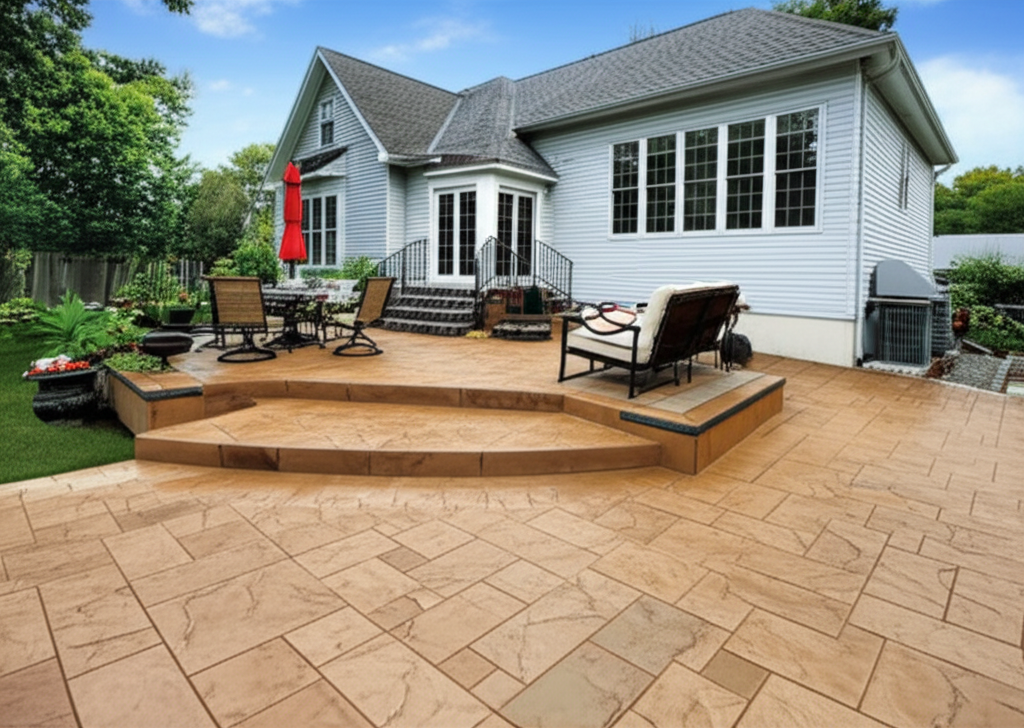
A fresh, well-done stamped concrete patio looks impressive. The seamless surface, consistent color, and smooth transitions create a clean, unified appearance. Stamped concrete looks particularly good on large open surfaces — pool surrounds, big rectangular patios, long driveways — where the monolithic quality is an advantage.
From a distance, quality stamped work is convincing. It genuinely looks like stone.
The limitation: Stamp patterns repeat. Each stamp mat covers a few square feet, then the same pattern starts again. Walk across a stamped patio and look carefully — you’ll see the repetition every 3–4 feet. It’s the thing that gives it away up close. This bothers some people. Others never notice.
Paver Strengths
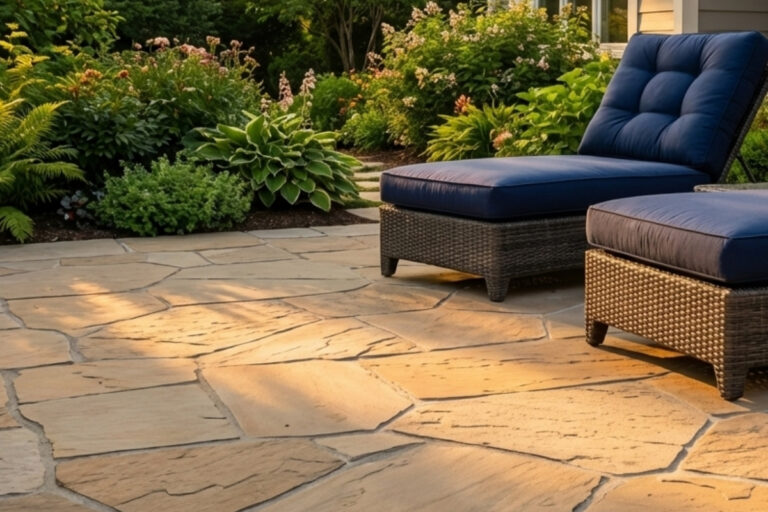
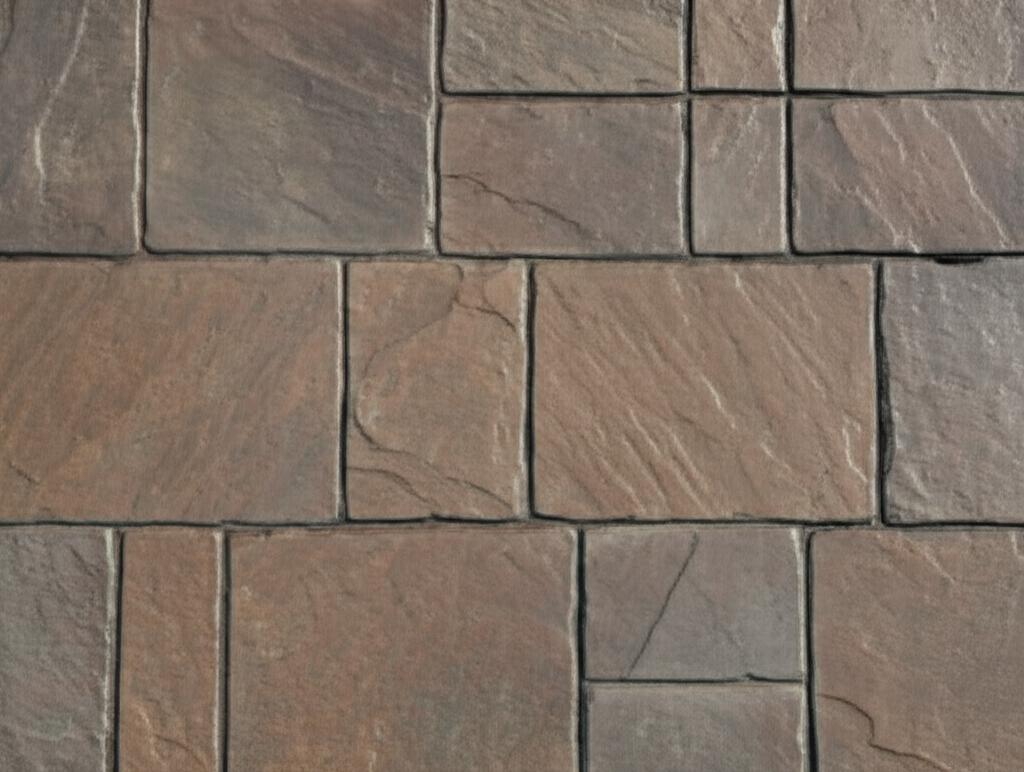
Every paver is an individual piece, so there’s no pattern repetition. The variation in unit-to-unit color (especially in tumbled or blended products from Unilock, Belgard, or Techo-Bloc) creates a natural visual depth that stamped concrete simulates but doesn’t replicate.
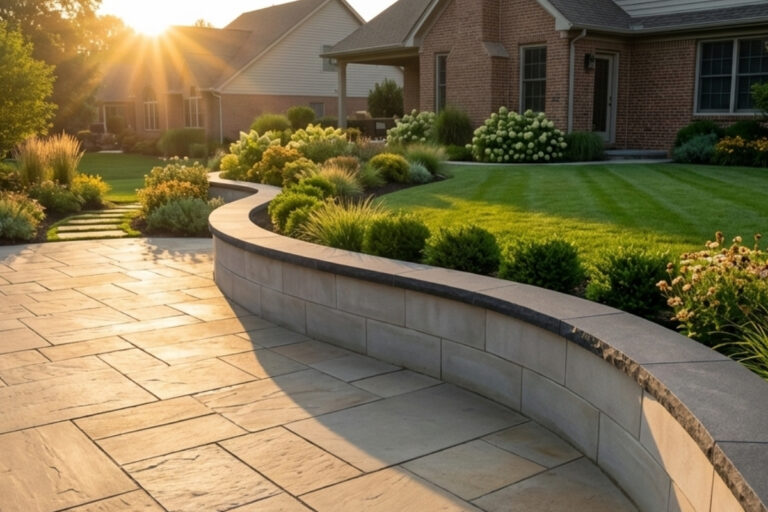
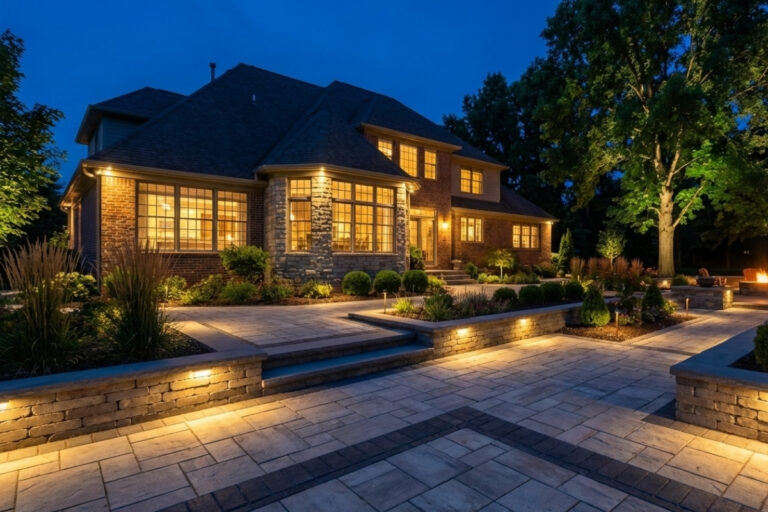
Pavers handle complex geometry better — curves, multi-level transitions, mixed-material borders, integration with walls and steps. Any shape, any layout, any combination of products. The design flexibility is where pavers pull ahead. Check our patio ideas for examples of what’s possible with pavers.
The limitation: Joints. Pavers have visible joints between every unit. Some people love the texture. Others prefer the seamless look of stamped concrete. It’s a preference, not a flaw.
When Stamped Concrete Is the Better Choice
I’m not going to tell you pavers are always the answer. Stamped concrete is the right call when:
- Budget drives the decision. If the choice is between a stamped concrete patio and no patio, get the stamped concrete. It looks good, functions well, and delivers value at $15–$20/sqft.
- You want a seamless surface. Pool decks, large minimalist patios, and spaces where furniture stability matters — the joint-free surface has real advantages.
- The project is simple and flat. A single-level rectangular patio without walls, steps, or future modification plans is stamped concrete’s sweet spot.
- You’re selling in 5–10 years. The patio will look great during that window. Long-term maintenance becomes the next owner’s concern.
When Pavers Are the Better Choice
- You’re staying put. Ten-plus years of ownership is where pavers’ durability advantage compounds.
- Complex design. Multi-level patios, curved edges, mixed materials, retaining wall integration — pavers handle complexity that stamped concrete can’t.
- Future changes likely. Adding a fire pit, extending the patio, running a gas line — pavers accommodate modifications without destruction.
- You’re on clay soil. Most of Cuyahoga, Medina, and Lorain counties sit on heavy clay. Ground movement is guaranteed. Pavers handle it. Concrete fights it.
- Low-maintenance priority. Pavers need less ongoing attention than stamped concrete, despite what some contractors claim.
What About the Combination?
A few people pick stamped concrete for wide spaces because it covers well without high cost. Pavers show up too – not just anywhere – but in touches here, edges there, maybe around a fire place. This mix appears natural, even planned. It lets concrete handle the bulk area while pavers add shape and control look exactly where needed.
Here’s the thing. These two substances shift temperature differently. When moving from concrete to pavers, the seam must be handled carefully – use a soft joint filler instead of stiff mortar. If executed correctly, results can improve. Fails badly – the joint splits open.
Our Take
When it comes to home patios around Northeast Ohio, pavers often feel like the right choice. Sure, they hit your wallet harder at first – but only slightly when looked at alongside the whole bill. What sticks around longer is how well they handle extreme weather shifts like repeated thawing and freezing. Fixing cracks stays practical too, unlike some options that fall apart fast. Creativity in layout also gets a boost with pavers compared to flat alternatives. That kind of durability and control? It adds up without blowing the whole budget.
Still, we often lay stamped concrete, making sturdy patios with it. This stuff holds up just fine if done right and kept up over time. Picking concrete? It’s perfectly fine – spending more on pavers makes little sense when your setup suits stamped options better.
Here’s what matters: picking something without seeing the full picture. That clears up the issues, does it?
Frequently Asked Questions
Is stamped concrete lower-cost than pavers?
Yes — upfront. Stamped concrete runs $15–$30/sqft vs. $25–$50/sqft for pavers. But stamped concrete requires resealing every 2–3 years and has a shorter lifespan. The total cost over 20 years is closer than the initial price difference.
Which lasts longer in Ohio?
Pavers. A properly installed paver patio lasts 25–50+ years with minimal maintenance. Stamped concrete lasts 15–25 years before surface wear and cracking warrant replacement. Both timelines assume quality base construction.
Can you make stamped concrete look like pavers?
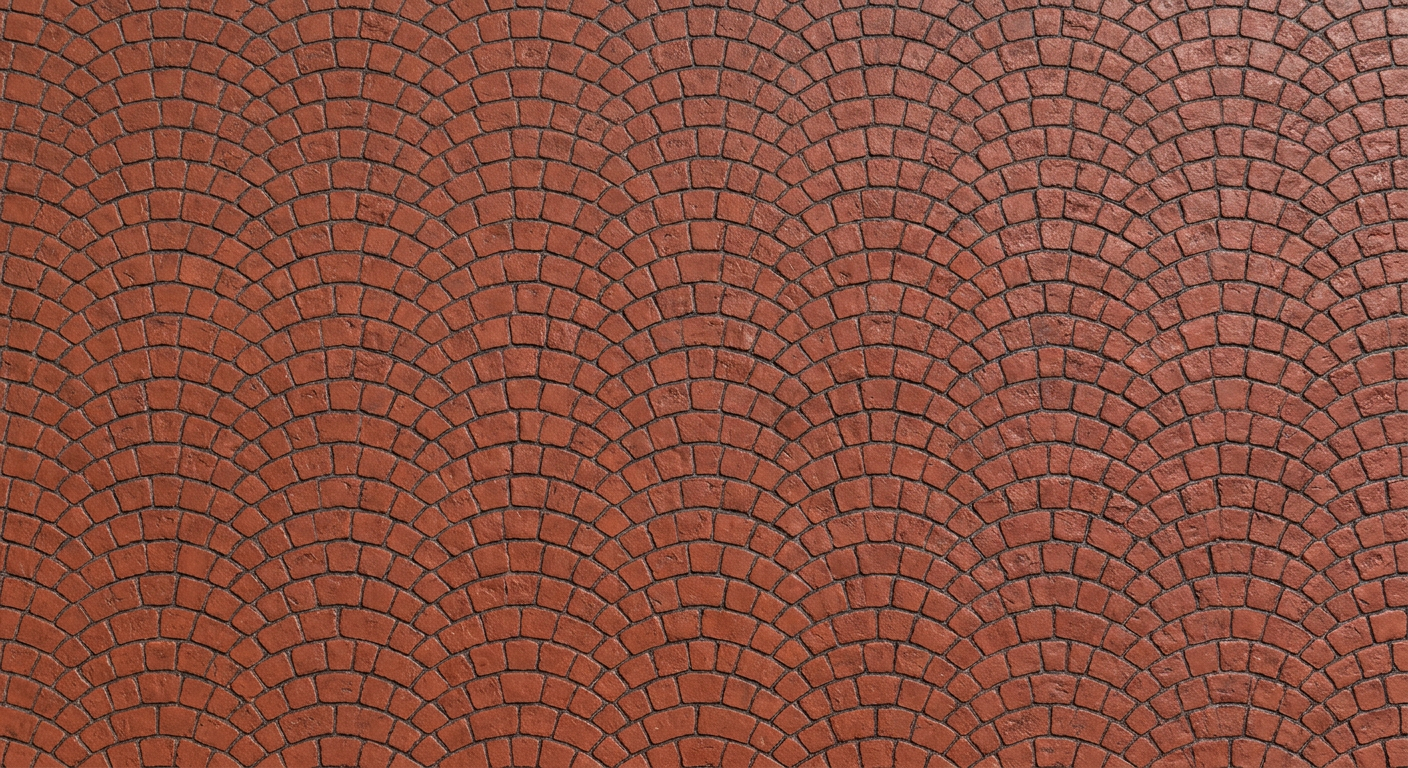
Sort of. Stamp patterns replicate brick, cobblestone, and other paver-like appearances. From a distance, the effect is convincing. Up close, the pattern repetition and lack of individual unit variation are noticeable. It’s an approximation, not a match.
Which is better for a driveway?
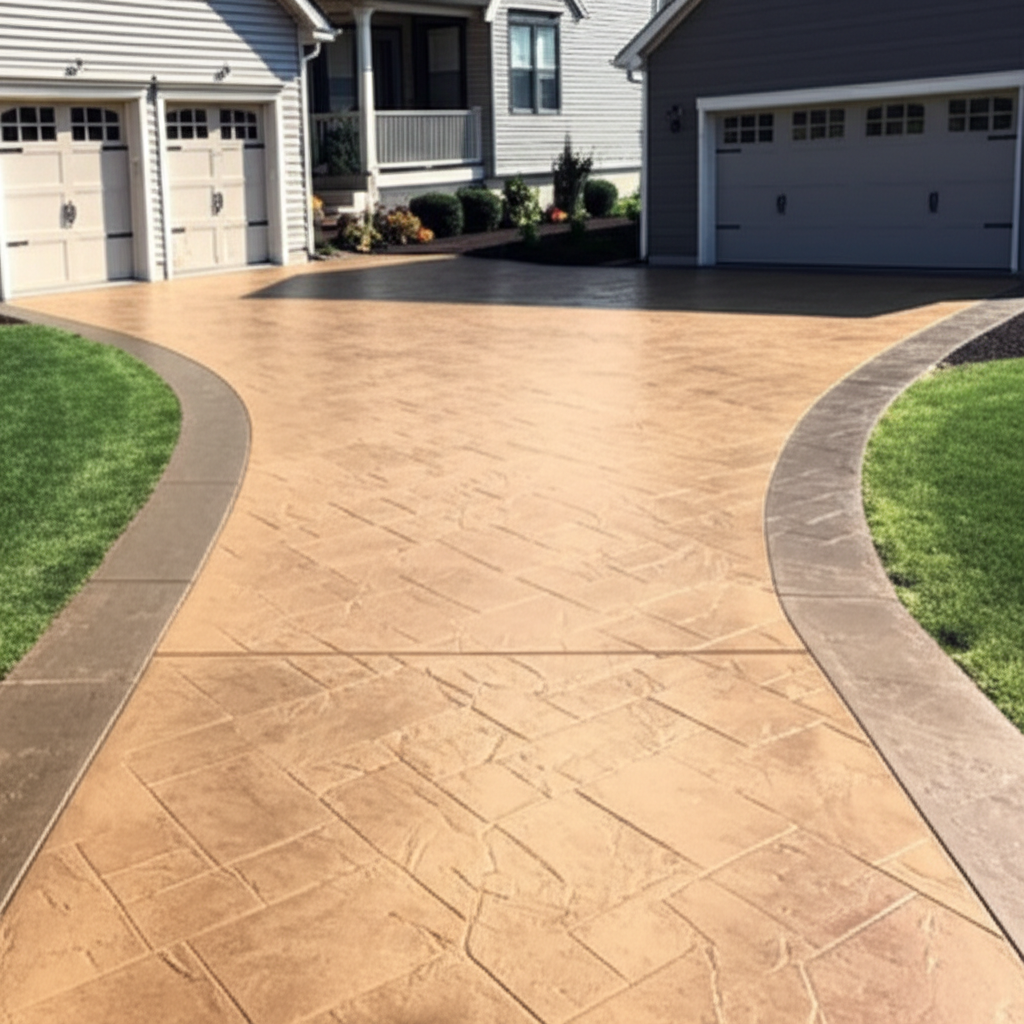
Both work, but pavers handle vehicular loads better long-term. Vehicular-rated pavers exceed 10,000 PSI and are individually replaceable. Stamped concrete driveways are less expensive but more prone to cracking under repeated vehicle loads and harder to repair. For driveways with significant aesthetic goals, pavers are worth the investment.
Do pavers get weeds between them?
Polymeric sand — a specialized joint fill that hardens when activated with water — prevents weed growth in the joints. It needs refreshing every 5–8 years. Between applications, occasional spot weeding may be needed. Stamped concrete has no joints, so no weed issue — but it has cracks, which can also grow weeds over time.
Still deciding? The best way to choose is to see both materials and discuss your specific conditions — slope, soil, drainage, budget, design goals. Request your design consultation and we’ll walk through both options honestly. For a broader look at all patio material options, see our best patio materials guide.
Bee Green Outdoor Living installs both stamped concrete and paver patios across Greater Cleveland, Medina County, and Lorain County.