How Much Does a Retaining Wall Cost? (2026 Pricing)
Retaining wall pricing is the question we get asked most during initial consultations — and it's the hardest to answer with a single number. A 2-foot landscape wall and a 6-foot structural wall are fundamentally different projects with fundamentally different engineering, materials, and labor requirements.
So let me give you the ranges, then explain what drives the price so you can estimate where your project falls.
Quick answer: Retaining walls in Northeast Ohio cost $35–$90 per face square foot installed in 2026, depending on material, height, and site conditions. A face square foot is the wall's exposed height multiplied by its length. A 30-foot-long, 3-foot-tall wall = 90 face square feet.
For most residential projects, that translates to $3,000–$15,000 for a single wall. Multi-wall terracing systems on steep lots can run $20,000–$50,000+.
Cost by Material
Segmental Block (SRW): $35–$60 per Face Sqft
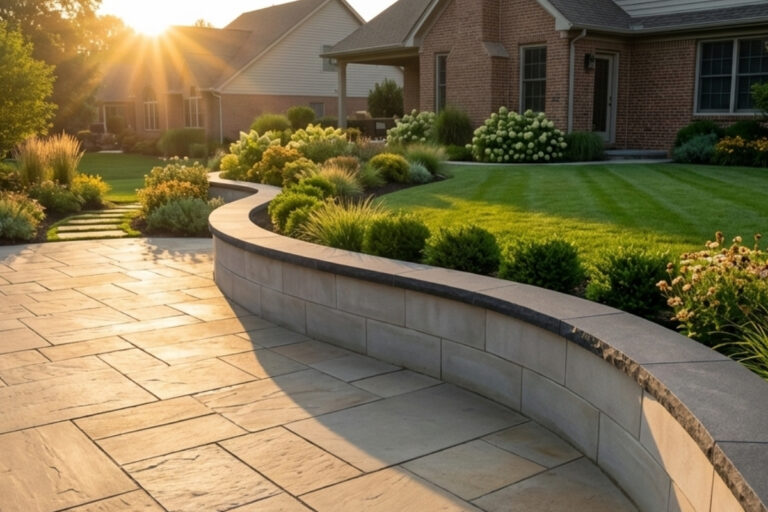
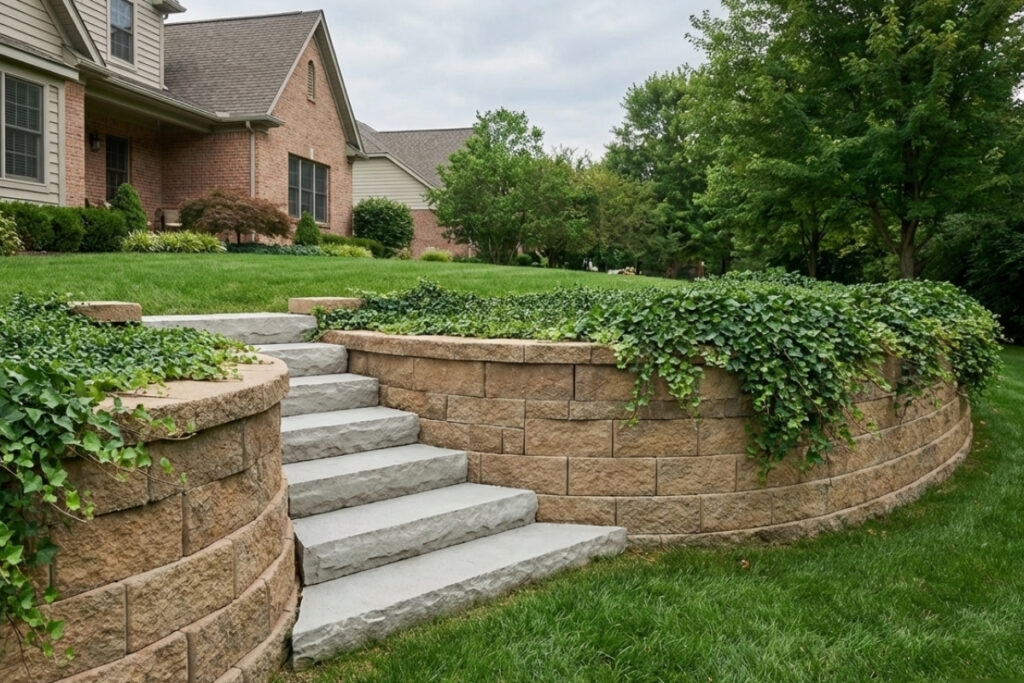
Manufactured concrete block systems — the most common residential retaining wall material. Products from Belgard, Unilock, Versa-Lok, and Allan Block are engineered to stack and interlock without mortar. Available in multiple textures and colors to match or complement your patio pavers.
Why the range?
- Standard block (split face, single color): $35–$45/face sqft
- Premium block (tumbled, multi-tone, large-format): $45–$55/face sqft
- Block with natural stone cap: add $8–$15/linear foot for the cap
What's included: Excavation, compacted aggregate footing, block installation, backfill, drainage gravel and perforated pipe, filter fabric, and cap installation.
Typical project costs:
| Wall Size | Standard Block | Premium Block |
|---|---|---|
| 20 ft long x 2 ft tall | $1,400–$2,200 | $1,800–$2,800 |
| 30 ft long x 3 ft tall | $3,150–$4,800 | $4,050–$5,400 |
| 40 ft long x 4 ft tall | $5,600–$9,600 | $7,200–$10,400 |
| 50 ft long x 5 ft tall* | $8,750–$15,000 | $11,250–$16,500 |
*Walls over 4 feet require geogrid reinforcement and typically engineering/permits — both included in pricing.
Natural Stone: $50–$90 per Face Sqft
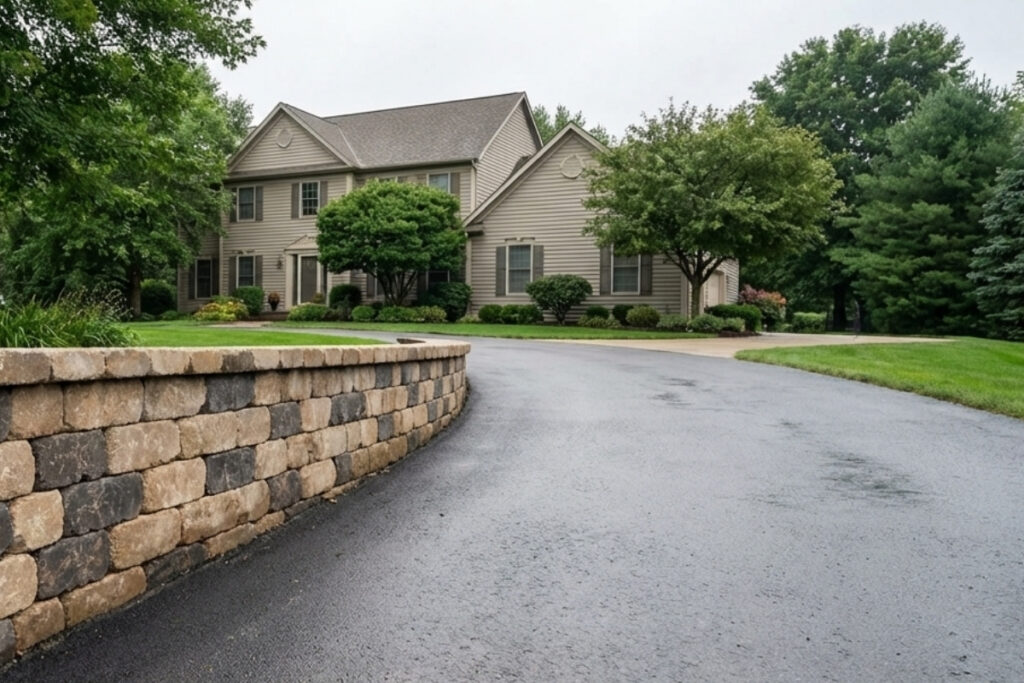
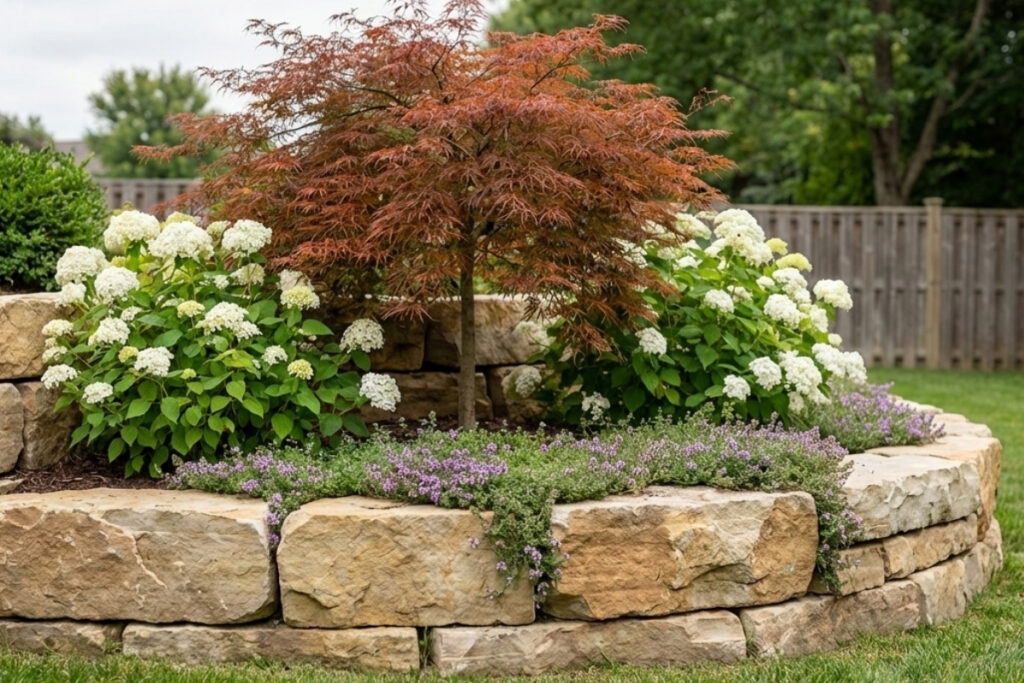
Fieldstone, limestone, sandstone, or granite — either dry-stacked or mortared. Natural stone walls are the premium option, chosen when the wall is a prominent visual element: along a front walkway, flanking a driveway entrance, or forming a garden terrace visible from the house or street.
Cost drivers:
- Dry-stacked natural stone: $50–$70/face sqft. Appropriate for walls up to 3 feet. Requires skilled hand-placement — labor-intensive.
- Mortared natural stone: $65–$90/face sqft. Built on a concrete footing. More structural permanence. Required for taller walls.
- Stone type matters. Local Ohio fieldstone is less expensive than imported Pennsylvania bluestone or New England granite. Material cost can range from $8 to $25+ per face square foot depending on the stone.
Typical project costs:
| Wall Size | Dry-Stacked | Mortared |
|---|---|---|
| 20 ft long x 2 ft tall | $2,000–$2,800 | $2,600–$3,600 |
| 30 ft long x 3 ft tall | $4,500–$6,300 | $5,850–$8,100 |
| 40 ft long x 4 ft tall | — | $10,400–$14,400 |
Boulder Walls: $30–$55 per Face Sqft
Large natural boulders (1,000–5,000 lbs each) placed with an excavator. Boulder walls have a rugged, natural aesthetic and work well on properties where a formal block or stone wall would look out of place — wooded lots, lakefront properties, rural settings in Medina and Lorain counties.
Cost is driven by:
- Boulder sourcing (local vs. quarried vs. imported)
- Equipment access (excavator needed; tight access increases cost)
- Wall height (boulder walls are typically best for 2–5 foot applications)
Typical project costs:
| Wall Size | Cost Range |
|---|---|
| 30 ft long x 3 ft tall | $2,700–$5,000 |
| 50 ft long x 4 ft tall | $6,000–$11,000 |
Boulder walls are less precise than block or stone — they're designed to look natural, not geometric. The cost per face square foot can be lower than block, but the tradeoff is less visual precision and less ability to integrate with formal hardscape elements like paver patios.
Poured Concrete: $40–$75 per Face Sqft
Formed, reinforced, and poured concrete walls. Used for heavy structural applications (supporting driveways, significant grade separations, or structures above) or modern/industrial aesthetics where the exposed concrete face is the design intent.
Cost factors:
- Forming labor (building and stripping forms is significant labor)
- Steel reinforcement (rebar cage)
- Concrete volume and pumping
- Finish treatment: raw/exposed ($40–$55), form-lined or board-formed ($50–$65), stone veneer applied over concrete ($65–$75+)
Poured concrete walls are the strongest option and the best choice when engineering demands maximum structural capacity. They're also the most expensive to build due to the forming and reinforcement labor.
What's Included in These Prices
Every retaining wall we build includes these elements — they're non-negotiable in our construction process:
Base construction:
- Excavation to undisturbed subgrade
- Compacted aggregate footing (SRW) or poured concrete footing (mortared/poured walls)
- First course set below grade for stability
Drainage (the most important component):
- 12-inch zone of clean drainage gravel behind the wall face, full height
- 4-inch perforated drain pipe at the base, sloped to daylight or storm connection
- Filter fabric between gravel and retained soil
- The NCMA identifies drainage failure as the #1 cause of retaining wall failure. We don't skip this.
Wall construction:
- Block, stone, or concrete installation per engineered specs
- Geogrid reinforcement where required (walls over 4 ft or walls with surcharge)
- Cap stone installation
- Backfill with compacted structural fill
Finish work:
- Site grading and restoration
- Disturbed lawn areas seeded or sodded
- Construction debris removal
If a contractor's quote is significantly below these ranges, ask what's included. The most common cost-cutting shortcuts — inadequate drainage, no geogrid where it's needed, shallow footing, no filter fabric — are the ones that cause wall failure.
What Adds to the Cost
Height
Cost increases disproportionately with height. A 6-foot wall doesn't cost twice as much as a 3-foot wall — it costs 2.5 to 3 times as much. Here's why:
- Geogrid reinforcement is required (material + extended excavation for the reinforced zone)
- Engineering is required (stamped drawings: $1,500–$3,000)
- Building permit is required ($200–$500)
- Footing is deeper and wider
- More base material, more backfill, more drainage aggregate
- More labor hours per face square foot
Access
If the wall is in a tight backyard accessible only through a gate, materials must be wheeled or carried in by hand. No equipment access means significantly more labor. Open site with truck access to the wall location? Much more efficient.
Soil Conditions
Northeast Ohio's clay soil is heavy, holds water, and creates higher lateral pressure on wall faces than sandy or loamy soils. Walls in heavy clay require more robust drainage and sometimes additional reinforcement compared to walls in better-draining soil. Properties in the lowlands of Cuyahoga and Lorain counties often have the most challenging clay conditions.
Surcharge Loads
If a driveway, patio, structure, or heavy vehicle will be above the wall, the wall must be designed for that additional load (surcharge). This typically means more geogrid layers, deeper reinforcement zone, and heavier base construction — all adding cost.
Terracing vs. Single Wall
A single 6-foot wall requires full engineering and substantial reinforcement. Two 3-foot walls with a 4–6 foot terrace between them each qualify as shorter walls (possibly avoiding the engineering threshold) and create usable terrace space. The total cost of two shorter walls plus the terrace may be similar to or slightly more than a single tall wall, but you gain additional usable space and a more attractive result.
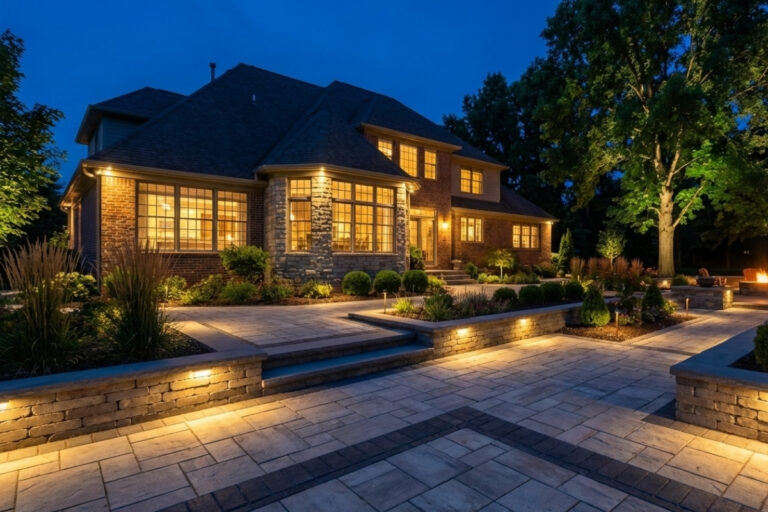
We build terraced wall systems across Brecksville, Broadview Heights, and the hilly properties of Medina County as a standard approach for grade changes over 4 feet.
How to Budget Your Retaining Wall Project
Simple landscape wall (under 3 ft, 20–30 ft long, standard block): $2,000–$5,000.
Standard residential wall (3–4 ft, 30–50 ft long, drainage, block or stone): $5,000–$15,000.
Tall/engineered wall (4–6 ft, geogrid, engineering, permits): $12,000–$30,000.
Multi-wall terracing system (two or more walls, total grade change 6+ ft): $20,000–$50,000+.
Wall integrated with patio project: The wall is typically 20–35% of the total project cost when it's part of a larger outdoor living build with patio, steps, and fire features. Our hardscaping cost guide breaks down complete project pricing.
Frequently Asked Questions
How much does a small retaining wall cost?
A small landscape wall (2 feet tall, 15–20 feet long) in segmental block costs $1,200–$2,500 installed with proper drainage. This is the most affordable retaining wall project and handles modest grade changes, planting bed definitions, and minor erosion control.
Is a retaining wall worth the investment?
If you need one — for structural reasons (erosion, drainage, foundation protection) — absolutely. The cost of not building a wall when one is needed (ongoing erosion, foundation damage, unusable yard) exceeds the wall cost over time. For walls that create usable space (patio terracing, level lawn areas), the value is both functional and financial. See our guide to when you actually need a wall.
Do retaining walls need maintenance?
Minimal. Segmental block walls need occasional inspection of the drainage outlet to confirm it's flowing. Check for any soil settling behind the wall after the first year. Natural stone walls may need occasional repointing (mortared) or resettling of shifted stones (dry-stacked). Well-built walls with proper drainage are essentially maintenance-free for decades.
Why do retaining wall quotes vary so much between contractors?
Drainage. It's almost always drainage. The contractor quoting 40% less is probably not installing 12 inches of drainage gravel, a perforated pipe, or filter fabric. Their wall will look the same on day one. By year 3–5, the wall without drainage starts to lean. By year 8–10, it fails. The drainage alone can represent 15–25% of the total wall cost — cutting it is the easiest way to lower a bid.
Can I build a retaining wall in winter?
Block walls can be built in cold weather as long as the ground isn't frozen solid (excavation becomes difficult/impossible in frozen ground). Mortared stone and poured concrete walls need sustained temperatures above 40°F for curing. In practice, our retaining wall season runs April through November, with the occasional early December project when weather cooperates.
Need a retaining wall? Request your design consultation — we'll evaluate your slope, soil, and drainage conditions and give you a detailed estimate for your specific project. No generic pricing — a real number based on what your property actually needs.
Bee Green Outdoor Living designs and builds retaining walls across Greater Cleveland, Medina County, and Lorain County.