How Much Does a Patio Cost in Cleveland? (2026 Pricing)
Maybe you’re typing “patio cost” into Google, sitting at your desk, trying to figure things out. That moment makes sense — most people want to know how much they’re looking at before reaching out. I’ve been there too, talking through ideas with homeowners around Cleveland and nearby counties, back for years now. Every first talk, no exception, drifts straight into money talk.
Truth is, that comes first. Around it, every detail fits like pieces finding their place.
A patio put in place during the Cleveland area year, costing $25–$70 per square foot dollars if materials go up in 2026. When it comes to people putting in paver patios between 400 and 600 square feet, the full price might land near $12,000–$28,000 dollars total.
That’s a big spread. Let’s peel into the reasons behind it — this might show where your effort truly sits.
2026 Patio Costs by Material
Fees cover what's built in place — material, labor, digging site holes, laying foundations beneath, guiding water away, securing edges firm. Work includes sealing cracks, cleaning up after workers leave, making sure the whole area levels down without lumps. This list mirrors costs for laying durable outdoor spaces through Northeast Ohio’s wetter seasons.
Concrete Pavers: $25 – $50 per Square Foot
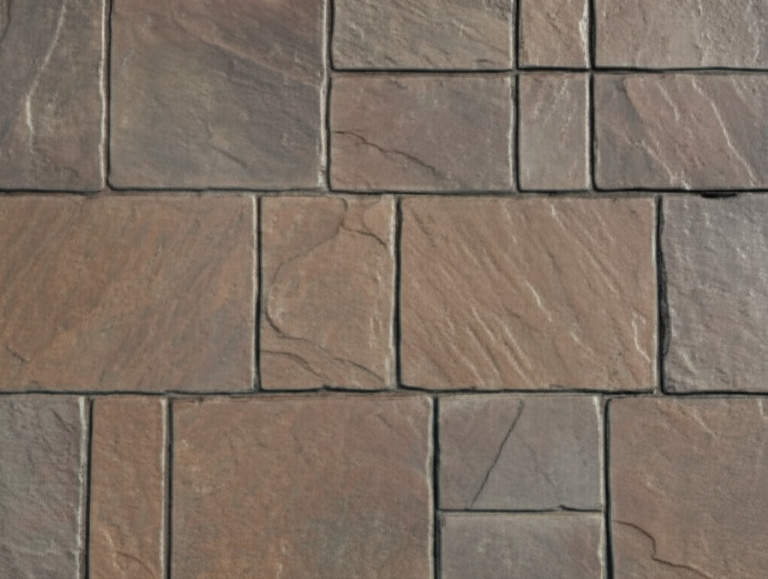
What we put in place quite a bit, this is also the choice suggested for many home builds. Made by firms like Unilock, Belgard, Techo-Bloc, and Cambridge, concrete pavers come with a built-in pressure resistance of above 8,000 pounds per square inch. That’s twice as much as solid poured concrete can handle.
Here’s how much you might spend depending on paver levels.
Paver type size per square foot installed 400 sq ft patio cost 600 sq ft patio cost
|—|—|—|—|—
| Standard tumbled (Holland, classic cobble) | $25–$32 | $10,000–$12,800 | $15,000–$19,200 |
Mid-range (Beacon Hill, Richcliff, Blu) $32–$42 $12,800–$16,800 $19,200–$25,200
Premium and large-format printers (Arcana, Borealis, Industria) $40–$50 $16,000–$20,000 $24,000–$30,000
Though pricing matches closely between options, higher-end pavers offer distinct visuals through thicker materials and unique designs. Premium versions stand out by using specialized textures and layouts — such as 24 by 24 or 24 by 36 inches — even if actual build expense stays nearly identical.
Natural Stone: $35 – $70 per Square Foot
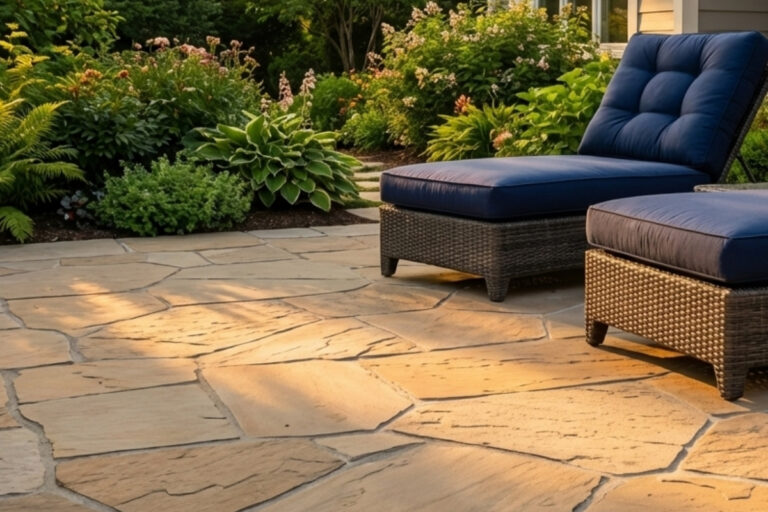
Bluestone, limestone, granite, and dimensional flagstone. Natural stone is quarried, not manufactured, so every piece has unique color and texture. It's the premium choice for homeowners who want something that doesn't look manufactured — because it isn't.
Typical installed costs:
- Pennsylvania bluestone (thermal finish): $40–$55/sqft
- Indiana limestone: $38–$50/sqft
- Granite (flamed finish): $45–$65/sqft
- Irregular flagstone (dry-laid): $35–$50/sqft
The higher per-square-foot cost reflects both the material premium and the additional labor. Cutting and fitting natural stone — especially irregular shapes — takes more time and skill than setting uniform manufactured pavers. Waste factor is higher too (10–15% vs. 5–8% for pavers).
That said, a bluestone patio ages beautifully. Twenty years from now it'll look better than it does the day we install it. You can't say that about every material.
Stamped Concrete: $18 – $30 per Square Foot
A monolithic poured surface with stamped texture and integral color. Stamped concrete is the most affordable per-square-foot option for a finished decorative patio surface.
Why the lower price:
- No individual unit installation — the concrete is poured, floated, stamped, and sealed as a continuous process
- Base requirements are less intensive (though we still install a compacted aggregate base for proper support)
- No edge restraint or joint fill needed
The tradeoff: Stamped concrete will crack. Controlled joints limit where cracks form, but they're inevitable. It also requires resealing every 2–3 years to maintain color and surface integrity. And if a section fails, you can't pull it up and replace just that section — the repair involves cutting out and repouring, which rarely matches the original perfectly.
For large, simple surfaces (600+ square feet, rectangular, single level), stamped concrete delivers good value. For complex designs, multi-level patios, or projects where future modification might be needed, pavers are the better long-term investment.
Porcelain Pavers: $40 – $70 per Square Foot
The newest material in residential patio construction and the fastest-growing category in our project mix. Porcelain pavers are kiln-fired at extreme temperatures, producing a surface with less than 0.5% water absorption — meaning freeze-thaw cycles have virtually no effect.
Why homeowners are choosing porcelain:
- Won't stain from food, wine, oil, or leaf tannin
- Color and texture are completely uniform
- Large-format sizes (up to 24×48) create a modern, minimal-joint look
- Scratch and wear resistant
The premium price reflects both the material cost and the installation precision required. Large-format porcelain pavers demand a flatter base tolerance than standard pavers — any imperfection in the setting bed telegraphs through the thin piece. Our crews laser-level the bedding layer for porcelain installations.
What's Included in These Prices
When you see our installed per-square-foot pricing, here's what's behind it. This matters because it's how you compare proposals from different contractors — not on the bottom-line number, but on what that number includes.
Base construction (non-negotiable in our builds):
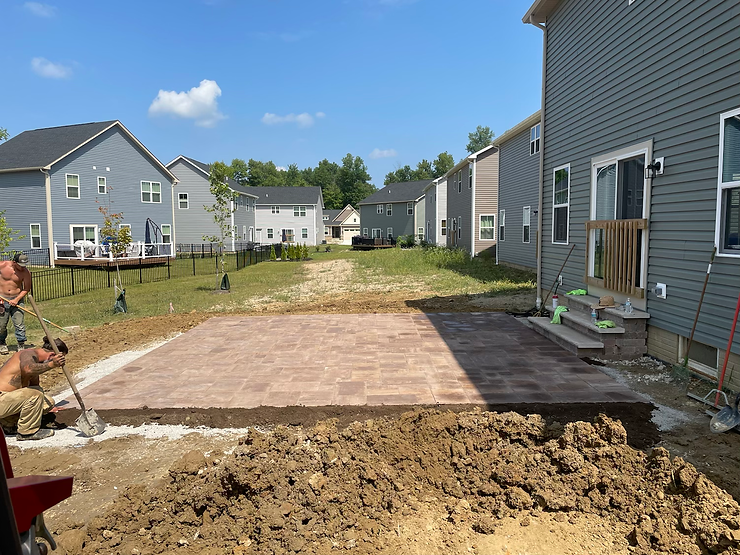
- Excavation to undisturbed subgrade (10–14 inches below finish grade)
- Non-woven geotextile fabric over clay subgrade
- 6–8 inches of ODOT 304 dense-grade aggregate, installed in 2–3 inch lifts, each compacted to 95% Proctor density
- 1-inch screeded bedding layer (ASTM C33 concrete sand)
Surface installation:
- Paver or stone placement per the design plan
- All cutting (wet saw for clean edges)
- Edge restraint (aluminum or heavy-duty plastic, 10-inch spikes)
- Polymeric sand joint fill, activated per manufacturer specs
Drainage:
- Positive grading away from all structures (minimum 1/8 inch per foot)
- Catch basins and/or channel drains where required
- Pipe connections to daylight or storm system
Finish work:
- Site cleanup and material removal
- Disturbed lawn areas restored (seed or sod)
- Walkthrough with the homeowner
If a contractor's quote doesn't include all of these elements, you're not comparing the same product. A $15/sqft patio on 3 inches of gravel with no geotextile and no edge restraint is not a patio — it's a surface that'll move within two winters. The ICPI publishes installation standards for a reason. We follow them.
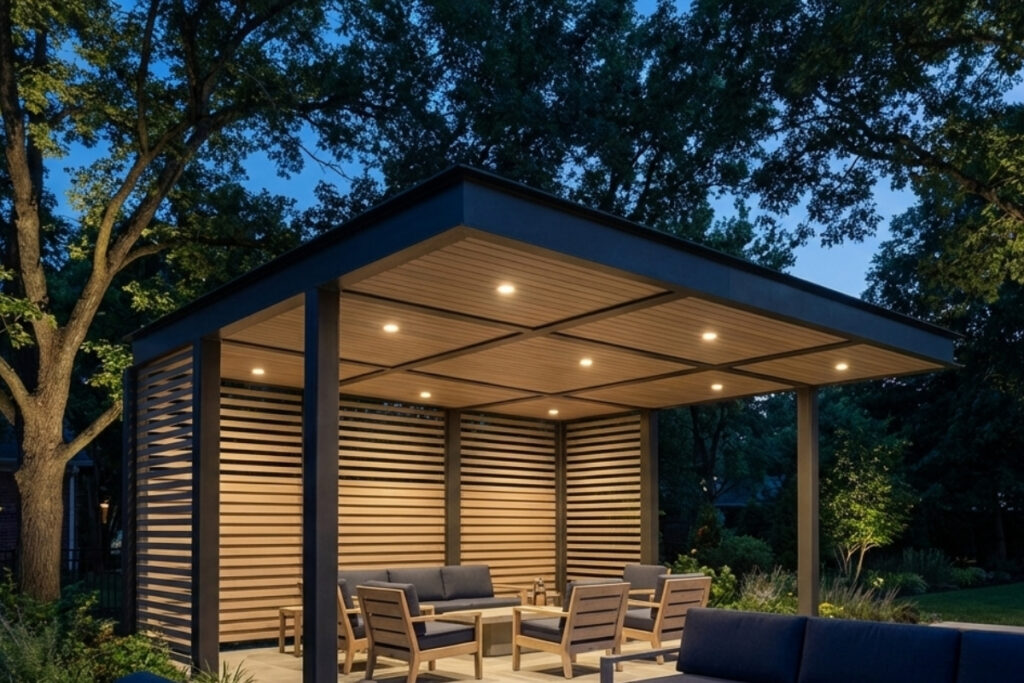
What Adds Cost Beyond the Patio Surface
The patio surface is usually 60–70% of the total project cost. These common additions make up the rest:
Steps: $150–$400 per step, depending on material and width. Most patios that are accessible from the house involve 2–6 steps to navigate the grade change between the door threshold and property level.
Retaining walls: If your property slopes, a retaining wall may be needed to create a level patio area. A 2–3 foot wall along one side of the patio adds $4,000–$10,000. See our retaining wall page for more detail.
Fire pit or fire feature: A built-in fire pit integrated into the patio design runs $3,500–$8,000. (Looking for design inspiration? See our patio ideas for Northeast Ohio.) It's one of the most popular additions and one of the most used — our clients with fire pits tell us they use their patio well into November and start again in March.
Outdoor kitchen base: The masonry island structure that houses a built-in grill and other appliances starts around $8,000–$15,000 for the base alone (countertops, appliances, and utilities are additional). See our outdoor kitchen page for full cost breakdowns.
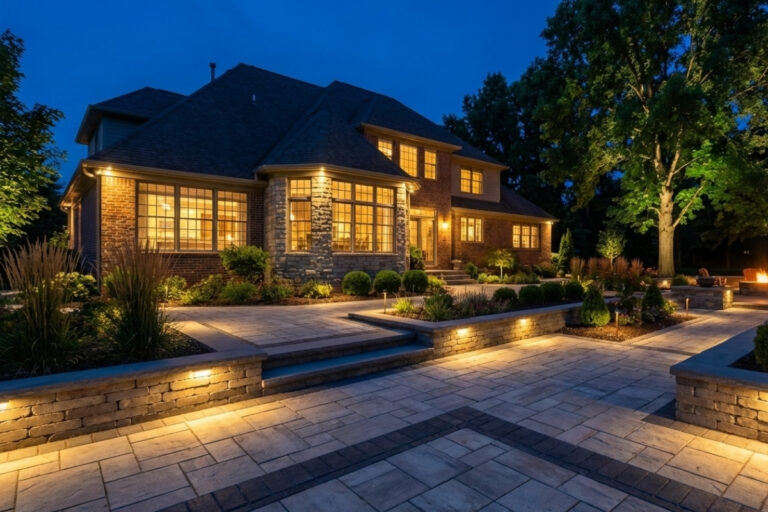
Landscape lighting: Low-voltage LED path lights, step lights, and accent lights integrated into the hardscape add $2,500–$6,000 depending on fixture count and complexity. Conduit is run during base construction — far more cost-effective than retrofitting after the patio is done.
Why Patio Costs Vary Between Contractors
Three quotes come your way, each might seem unlike the others — often, way off in style. That shift happens for specific reasons; knowing where to notice them helps.
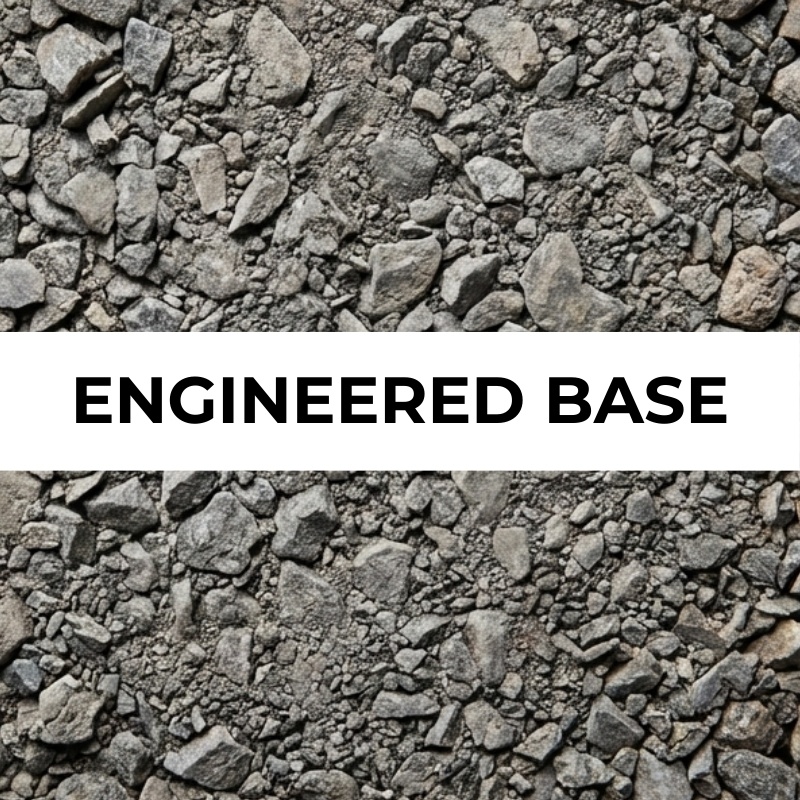
Building foundations often hide the most influence. A price tag like $18 per square foot might skip digging 12 inches, laying geotextile, compacting sand in stages, or checking density levels. Instead, dirt gets filled with gravel, then covered by flat stones. That number misses crucial groundwork. Same face at first glance. Changes by year three though
What you choose counts. A paver patio by itself shows nothing useful. Know who made it, what's written on the box, along with shades picked. That’s how you spot the real deal among offers. Comparing quotes just got clearer.
Drainage planning separates professionals from installers. Each patio moves water away from soil it used to absorb. What becomes of that flow remains unanswered. When rain hits the site, someone better have an answer ready — or it will show up in puddles near the house walls. Skipping this detail now means trouble later, like standing by while water collects where it shouldn’t.
How to Budget Your Patio Project
Truth is, if you ask me about laying bricks on houses like those over by Greater Cleveland, it comes down to what I’ve seen happen time and again.
For a basic patio with dining space (300–400 sqft, standard pavers, minimal grade change): Budget $10,000–$16,000.
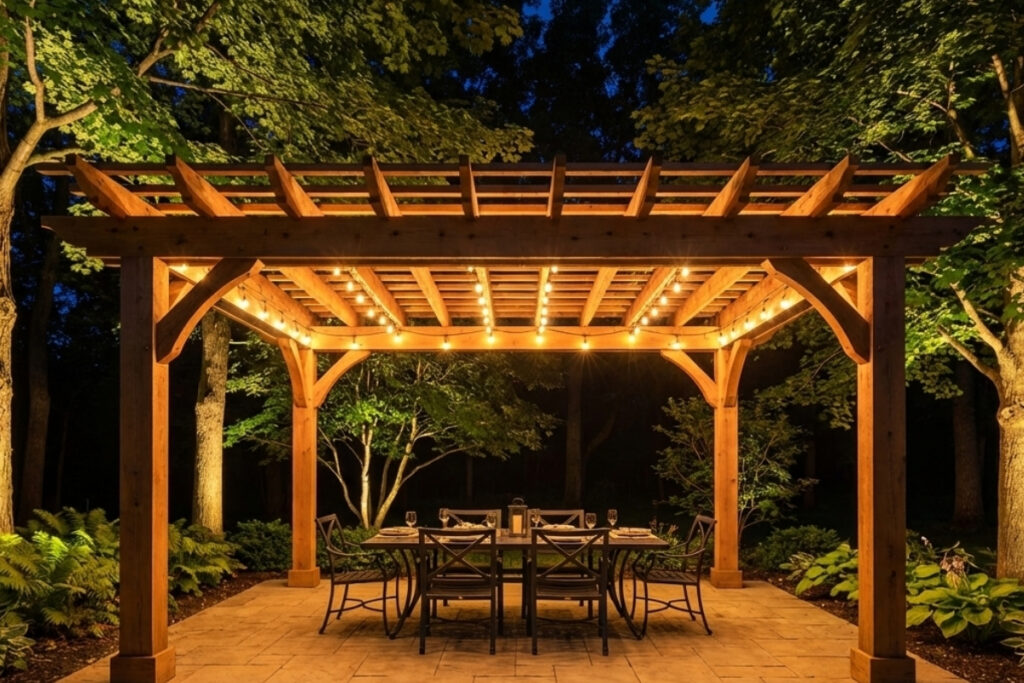
For a full outdoor living patio (500–700 sqft, mid-range pavers, some steps, fire pit area): Budget $22,000–$40,000.
A wide spread layout includes patios at different levels along with retaining walls plus an outdoor kitchen area and fire element. Cost sits around $45,000–$80,000+. Details on wall and pathway rates appear in our hardscaping cost guide.
Higher than you thought? That makes sense. Picture a space just like any standard indoors — but here, prices climb to 5 to 10 times that base range — around 66 thousand dollars — and it sits unused most autumn mornings while the backyard hums with weekends.
Frequently Asked Questions
Is a paver patio more value than stamped concrete?
Stamped concrete runs about $18–$30/sqft installed. Standard pavers run $25–$35/sqft. So concrete costs less upfront. But concrete requires resealing every 2–3 years ($1–$2/sqft each time), will crack over time, and can't be spot-repaired. Over a 20-year lifespan, the total cost of ownership is similar — and pavers give you a surface you can actually maintain and repair.
How long does patio installation take?
A straightforward 400 sqft paver patio takes about 5–7 working days from excavation to finished surface. Larger projects with walls and multiple levels take 2–4 weeks. Weather is a factor — we don't compact bases or set pavers in standing water, so significant rain events can push the schedule.
Can I build a patio in phases?
Yes, and we recommend it when the full scope exceeds your current budget. We design the complete plan upfront, install the core patio surface in phase one, and build additional elements (fire pit, walkway extension, retaining wall, kitchen) in subsequent seasons. The key is planning the drainage and base infrastructure for the full build from the start, even if you're only installing part of it now.
What's the best patio material for Northeast Ohio?
For most residential projects, we recommend concrete pavers. They handle freeze-thaw cycling better than poured concrete (flexible joints absorb movement instead of cracking), they're individually replaceable, and the range of styles available covers everything from traditional to ultra-contemporary. We wrote a full comparison of patio materials for Ohio weather if you want to go deeper.
When should I contact a contractor for a spring patio project?
January or February. Seriously. Design work takes 2–4 weeks, and our construction calendar fills by March for spring starts. If you call in May, you're looking at a July or August start date at the earliest. The best projects happen when there's time for a thorough design process — not a rush to squeeze in before fall.
Want to know what your specific project will cost? Online guides get you in the ballpark, but every property has its own conditions — drainage patterns, grade changes, access, soil. Request your design consultation and we'll give you a real number, not a range.
*Bee Green Outdoor Living designs and installs custom patios across Greater Cleveland and Northeast Ohio. From Columbia Station, we serve Cuyahoga, Medina, and Lorain counties.